




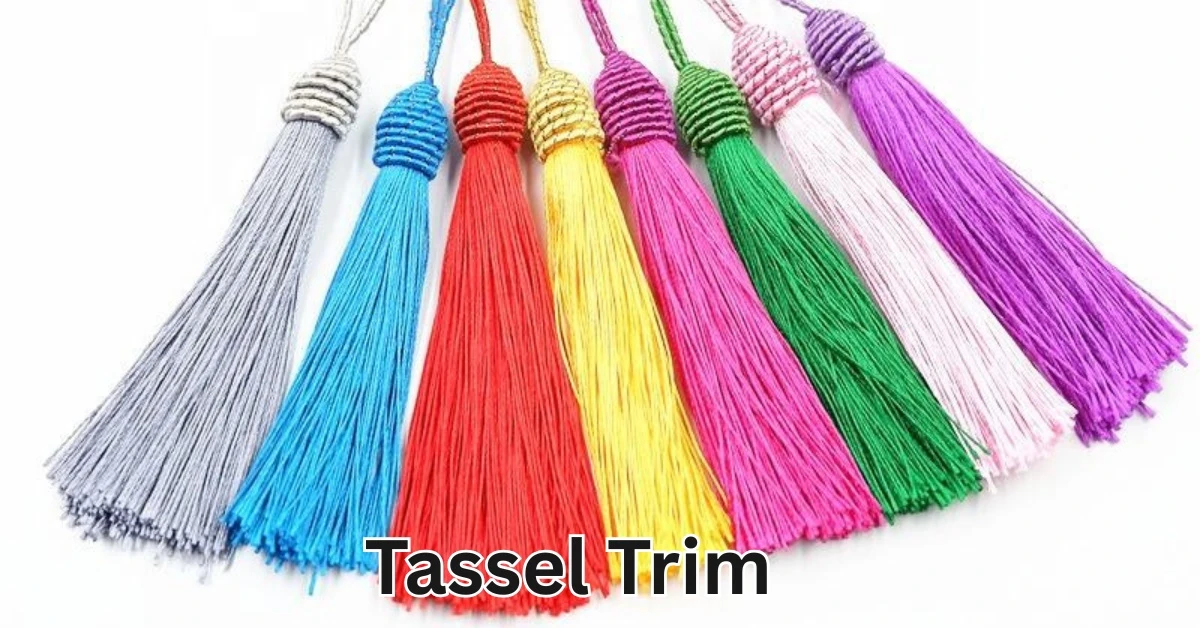
Tassel trim sits among the top 10 decorative trims used in fashion, home décor, and craft industries. Many brands use it to add style, movement, and character. You see tassel trim on almost everything from cushions to dresses, scarves, ponchos, and even handbags.
So what is tassel trim? In simple words, it is a decorative fringe made from small bunches of threads grouped into tassels and attached to a braid or cord. These threads might be cotton, polyester, silk, rayon, jute, or blends. Some trims carry 20–50 tassels per meter, and premium trims go above 80 tassels per meter.
Table Of Contents
What Is Tassel Trim?
Tassel trim is a type of decorative edging that holds repeated tassels along a braid or tape. Each tassel comes from multiple yarn strands tied, wrapped, or knotted at the top. The trim offers texture, color, movement, and a sense of luxury.
Designers love it because it turns simple garments into statement pieces. Home décor brands sweep up tassel trims due to their charm and instant visual value. A simple pillow with tassel trim looks 40–60% more premium than one without it, according to many retail pricing strategies.
You may notice tassel trims under several names: tassel border, tassel lace, tassel fringe, and dangling fringe. The construction stays the same. The difference lies in yarn type, tassel density, braid width, and finishing.
Types of Tassel Trim
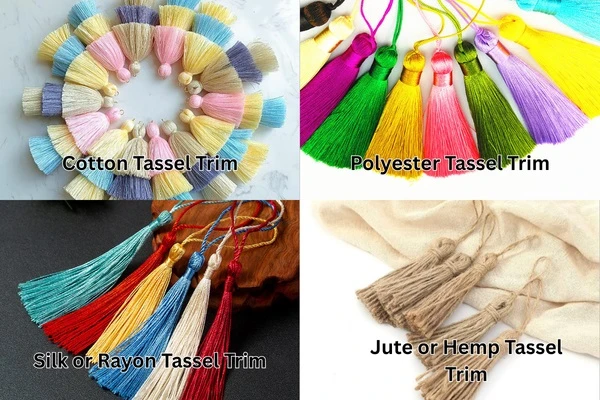

Based on Material
- Cotton Tassel Trim
Soft, breathable, and matte. Popular in boho fashion and summer garments. - Polyester Tassel Trim
Durable and colorfast. Ideal for curtains, bags, and upholstery. - Silk or Rayon Tassel Trim
Smooth and glossy. Used for luxury garments. - Jute or Hemp Tassel Trim
Rustic texture. Used in craft and eco-friendly décor.
Based on Style
- Mini Tassels
Often 1–2 cm long. Used in children’s wear and accessories. - Medium Tassels
3–5 cm. Common in ethnic wear. - Long Tassels
6–12 cm. Dramatic, bold designs. - Beaded Tassel Trim
Added beads for shine. - Braided Tassel Trim
Decorative braid under the tassels.
Based on Density
- Low Density: 10–20 tassels per meter.
- Medium Density: 25–40 tassels per meter.
- High Density: 50–80+ tassels per meter.
Higher density means a richer look but also a higher cost.
Handmade Tassel Trim
Handmade tassel trim carries a charm that no machine can copy. A skilled worker wraps, ties, cuts, and aligns each tassel manually.
Characteristics of Handmade Trim
- Better alignment control
- Unique texture because no two tassels match perfectly
- More time per piece (often 30–90 seconds per tassel)
- Higher production cost
- Irregularities that add personality
Advantages
- Premium look
- Custom color matching
- High flexibility in design
Disadvantages
- Slow production
- Expensive
- Higher variation between pieces
Best Uses
- Luxury garments
- Boutique pieces
- Event wear
- Limited edition décor items
Think of handmade tassels like handmade chocolate—imperfect but irresistible.
Machine-Made Tassel Trim
Machine-made trims come from automated tassel machines or multi-head fringe machines. A single machine can produce 30–50 meters per hour, depending on density.
Characteristics
- Uniform tassels
- High production speed
- Lower cost
- Consistent dyeing and finishing
Advantages
- Best price-to-quality ratio
- Fast delivery
- Ideal for mass production
- Minimal defect rate (often 1–2%)
Disadvantages
- Limited design freedom
- Less handcrafted charm
Best Uses
- Ready-to-wear garments
- Fast-fashion items
- Home décor
- High-volume accessories
If handmade tassels feel like artwork, machine-made trims feel like organized perfection.
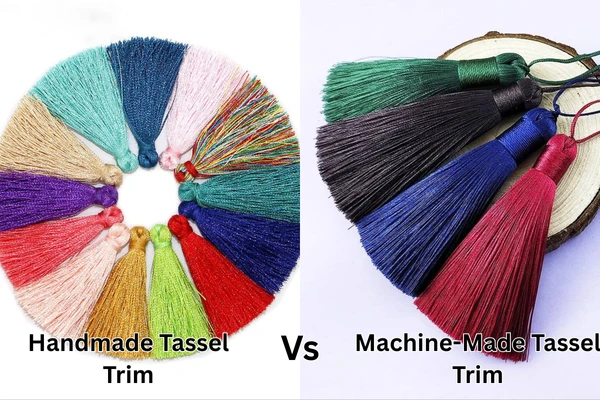
Handmade vs Machine-Made Tassel Trim
Cost Comparison
- Handmade trims cost 2–5 times more than machine-made.
- Machine-made trims reduce cost by at least 40–70%.
- High-density handmade trims sit among the most expensive decorative trims in the industry.
Quality and Appearance
- Handmade shows natural variation, giving life to each piece.
- Machine-made gives uniformity, ideal for retail products.
Production Volume
- Handmade workers produce 3–5 meters per hour.
- Machines produce 30–50 meters per hour.
- Large brands prefer machine-made due to scale.
Durability
Both types perform well, but the machine-made versions often show better knot strength due to controlled tension.
Environmental Impact
- Handmade trims consume less electricity.
- Machine-made trims use more power but generate less yarn waste.
How to Choose the Right Tassel Trim?
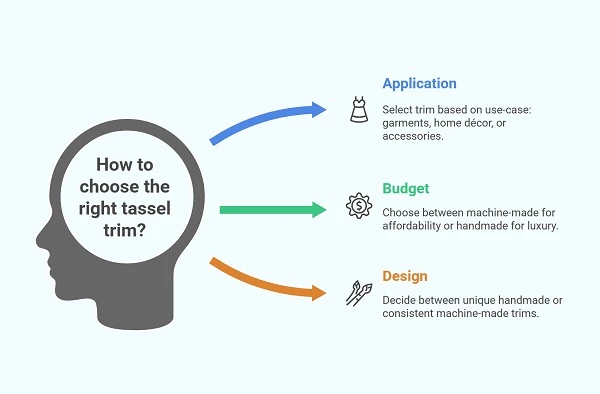
Consider the Application
- Garments → Medium or mini tassel trim
- Home décor → Medium or long tassel trim
- Bags & accessories → High-density polyester tassel trim
Consider the Budget
- Low budget → Machine-made
- High budget → Handmade
Consider the Design
- When you want uniqueness → Handmade
- When you want consistency → Machine-made
Common Quality Issues in Tassel Trim
For Handmade
- Uneven tassel length
- Loose knots
- Color variation
For Machine-Made
- Yarn breaks
- Stiff tassels
- Overly uniform texture (less character)
Final Tips from a Textile Technologist
If your product needs soul, handmade trims do magic. If your business needs bulk consistency, machine-made trims win. The right trim depends on your target market, budget, and brand identity.
I love both types. Handmade gives me emotional satisfaction. Machine-made gives me peace during inspection.
Conclusion
Tassel trim adds movement, charm, and personality to garments and décor. Handmade tassel trim offers rarity and craftsmanship, while machine-made trim delivers speed and consistency. The choice sits between character and practicality. Once you understand yarn types, density, and construction, picking the right tassel trim becomes easy and enjoyable.
FAQs
1. Is handmade tassel trim better than machine-made?
Both serve different needs. Handmade is unique. Machine-made is consistent.
2. What materials make the best tassel trim?
Cotton, polyester, rayon, and silk are the most common choices.
3. Which tassel trim lasts longer?
Machine-made trims usually last longer due to controlled tension.
4. How can I identify handmade tassel trim?
Look for slight variation in tassel length, knot shape, and yarn arrangement.
5. Is tassel trim suitable for kids’ clothing?
Yes, but mini tassel trims with strong knots are safer.

.webp)
Comments - 00
Leave A Reply
Thanks for choosing to leave a comment.